

When travellers think about Hue, the Imperial City, Thien Mu Pagoda and the grand royal tombs are usually the first places that come to mind. Yet beyond these famous landmarks lies another fascinating chapter of Vietnam’s royal history: An Dinh Palace.
Located beside the An Cuu River in the heart of Hue, An Dinh Palace is a remarkable residence connected with Emperor Khai Dinh and his son, Emperor Bao Dai, the last emperor of the Nguyen Dynasty. Unlike the traditional architecture most visitors associate with Hue, the palace presents a striking combination of Vietnamese royal decoration and European architectural influences, reflecting a period when Vietnamese court culture was entering a new era of cultural exchange.
What makes An Dinh Palace particularly interesting is its more intimate character. The Imperial City represents the public and ceremonial side of the Nguyen court, while An Dinh reveals a more private world of royal residences, family life and changing tastes. Walking through its decorated halls, visitors can discover not only architecture but also stories about Emperor Bao Dai, Queen Nam Phuong and the final decades of Vietnam’s monarchy. For travellers looking for something beyond Hue’s most crowded attractions, An Dinh Palace offers an opportunity to slow down and explore a lesser-known part of the city’s imperial heritage.
Discover An Dinh Palace: History, Architecture & Royal Stories
Show table of content
- 1. What Is An Dinh Palace?
- 1.1. Location and Historical Importance
- 1.2. From An Dinh Residence to Royal Palace
- 2. The History of An Dinh Palace
- 2.1. Prince Buu Dao and the Original Residence
- 2.2. Emperor Khai Dinh’s Reconstruction
- 2.3. Crown Prince Vinh Thuy and Emperor Bao Dai
- 2.4. Life After the Nguyen Dynasty
- 3. An Dinh Palace and Its Unique Architecture
- 3.1.The Main Gate
- 3.2. Trung Lap Pavilion
- 3.3. Khai Tuong Lau
- 3.4. European and Vietnamese Influences
- 4. The Beautiful Interior of An Dinh Palace
- 4.1. Decorative Murals and Mosaics
- 4.2. Royal Furniture and Personal Objects
- 4.3. The Story of Bao Dai’s Family
- 5. Why An Dinh Palace Is Different from the Imperial Citye
- 6. An Dinh Palace as Part of Hue’s World Heritage
- 7. What to See Near An Dinh Palace
- 8. How to Include An Dinh Palace in Your Hue Itinerary
- 9. Why You Should Visit An Dinh Palace
- Conclusion
1. What Is An Dinh Palace?
An Dinh Palace is a former royal residence of the Nguyen Dynasty located on Phan Dinh Phung Street beside the An Cuu River in Hue. The official tourism database places the site at 97 Phan Dinh Phung Street and identifies it as part of the Complex of Hue Monuments, which has been recognized as a UNESCO World Heritage Site.
Unlike the Imperial City, which was primarily associated with ceremonies, administration and public royal life, An Dinh Palace was a more personal residential space. Its history is closely associated with Emperor Khai Dinh and his son Bao Dai, giving the site an unusual connection with the final generation of the Nguyen imperial family.
The palace is particularly valuable because its architecture captures a moment of transition. Traditional Vietnamese royal motifs appear alongside European-inspired forms and decorative elements, creating a distinctive style that reflects the growing influence of Western culture in Vietnam during the early twentieth century. Hue Tourism describes the palace as an important example of Vietnamese neo-classical architecture and the combination of traditional Vietnamese decorative themes with European influences.
1.1. Location and Historical Importancen
Located beside the An Cuu River, An Dinh Palace is much closer to the modern city centre than many of Hue’s royal tombs. This makes it relatively easy to include in a city sightseeing itinerary without spending a large amount of time travelling outside Hue.
Its location is also significant because the palace represents the changing relationship between the royal family and the city itself. While the Imperial City remains the most prominent symbol of Nguyen authority, this residence gives visitors a more intimate look at the people who lived within the royal world.
Today, An Dinh Palace is managed as part of Hue’s heritage system and has been restored and preserved for visitors. The Hue tourism authorities describe it as a distinctive architectural and artistic monument within the World Heritage landscape.
1.2. From An Dinh Residence to Royal Palace
The story of An Dinh Palace actually began before it became the grand building visitors see today.
The original residence was established for Nguyen Phuc Buu Dao, who later became Emperor Khai Dinh. The official tourism database explains that the earlier residence was originally known as Phung Hoa Palace and was associated with Buu Dao before his accession to the throne.
In 1917, after becoming emperor, Khai Dinh ordered the residence to be reconstructed and expanded. The new building reflected a more modern architectural direction and retained the name An Dinh. According to Hue Tourism, the reconstruction was completed in early 1919.
This transformation is important because it explains why An Dinh Palace looks so different from many earlier Nguyen structures.
2. The History of An Dinh Palace
The history of An Dinh Palace is closely connected with the final stage of the Nguyen Dynasty. Unlike some royal monuments that mainly tell the story of an emperor’s reign or burial, An Dinh provides a glimpse into the residential life of the royal family during a period of major cultural and political change.
2.1. Prince Buu Dao and the Original Residence
Before becoming emperor, Nguyen Phuc Buu Dao was given a private residence in Hue. The official tourism records state that the original site was developed in the early twentieth century, while the later palace emerged from a major reconstruction commissioned after Buu Dao became Emperor Khai Dinh.
This private-residence origin is important because it distinguishes An Dinh Palace from the enormous ceremonial spaces of the Imperial City. It was designed for a more personal kind of royal life.
The earlier residence followed more traditional Hue architectural conventions, with elements such as timber-framed buildings, gardens and traditional landscaping. The later reconstruction introduced a much more modern architectural language.
2.2. Emperor Khai Dinh’s Reconstruction
After ascending the throne in 1916, Emperor Khai Dinh used his own funds to expand and rebuild the residence.
The reconstruction began in 1917 and was completed in early 1919. The resulting palace combined traditional Vietnamese decorative subjects with European architectural influences, making it one of the most distinctive royal buildings of the period. The timing is significant. Early twentieth-century Vietnam was experiencing increasingly strong French influence, and the royal court was interacting with European institutions, materials and aesthetics.
As a result, An Dinh Palace represents a fascinating moment when traditional court culture was adapting to a rapidly changing world.
2.3. Crown Prince Vinh Thuy and Emperor Bao Dai
In 1922, An Dinh Palace became the residence of Crown Prince Vinh Thuy, who later became Emperor Bao Dai. The official tourism database records that the palace was granted to the crown prince during the reign of Khai Dinh.
This connection makes the palace especially important for understanding the final generation of the Nguyen Dynasty. Bao Dai was the last emperor of Vietnam, reigning from 1926 until 1945. Vietnam Tourism notes that he spent part of his formative years at An Dinh Palace and returned there during his reign. The palace therefore provides an unusually personal perspective on Vietnam’s final imperial period.
Rather than focusing solely on ceremonies and political power, visitors can see spaces associated with family life, residence and daily activities.
2.4. Life After the Nguyen Dynasty
The history of An Dinh Palace did not end with the fall of the Nguyen monarchy.
After the August Revolution of 1945, Bao Dai’s family moved from the Imperial City to the palace, making it an important residence for the former royal family during the early post-monarchy period.
Later, the building experienced periods of changing use and deterioration. According to Hue’s official tourism information, the palace was eventually used for various public purposes and suffered significant degradation before restoration efforts began in the early 2000s.
The restoration of An Dinh Palace has therefore been important not simply for preserving a beautiful building, but also for protecting physical evidence of the final chapter of Vietnam’s imperial history.
3. An Dinh Palace and its Unique Architecture
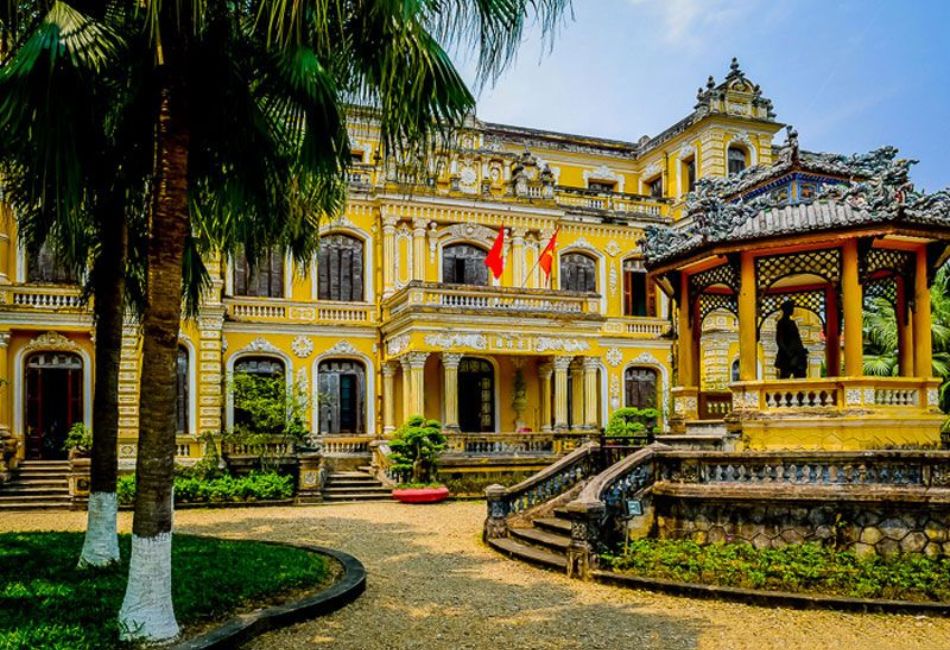
One of the strongest reasons to visit An Dinh Palace is its architectural character. The palace does not resemble a typical European building, nor does it follow the traditional appearance of older Nguyen residences. Instead, it creates a distinctive combination of Vietnamese royal motifs and European-inspired forms.
Hue Tourism describes the palace as an important representative of Vietnamese neo-classical architecture, with traditional Vietnamese decorative subjects combined with European themes.
3.1. The Main Gate
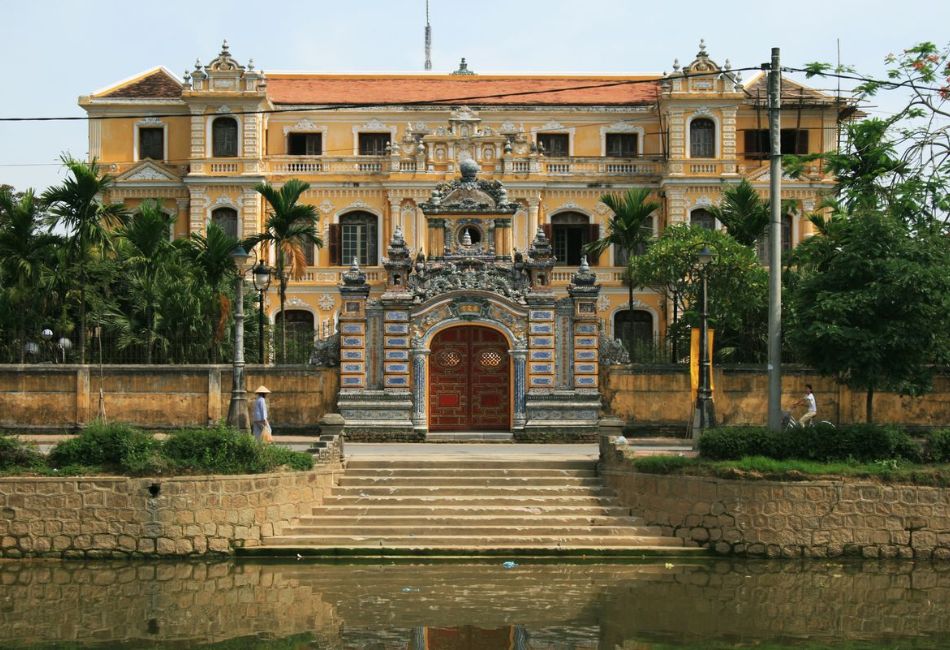
The main gate immediately demonstrates the unusual character of An Dinh Palace. It takes the form of a two-storey three-entrance gate and is decorated with elaborate raised ceramic and porcelain ornamentation. The upper roof is topped with a large pearl-like decorative motif, while the entire structure combines the formal language of a royal gate with highly decorative details.
Take time to look closely at the surface decoration. The craftsmanship becomes much more apparent when you examine the individual motifs rather than viewing the gate from a distance.
3.2. Trung Lap Pavilion
Inside the main gate, visitors encounter Trung Lap Pavilion, another important part of the palace complex. The pavilion contributes to the formal sequence of the entrance and introduces visitors to the architectural language of the palace before they reach Khai Tuong Lau.
The combination of traditional Vietnamese forms and more modern decorative treatment makes this part of the complex particularly interesting for architecture lovers.
3.3. Khai Tuong Lau
The centrepiece of An Dinh Palace is Khai Tuong Lau, the large principal building that contains some of the site’s most impressive interior decoration. This is where the palace’s European and Vietnamese influences become especially visible.
Inside, visitors can find decorated halls, preserved furniture, historical photographs and objects associated with the royal family. The building is not simply beautiful from the outside; its interior tells a much more personal story about life within the last generation of the Nguyen court.
3.4. European and Vietnamese Influences
The architectural style of An Dinh Palace reflects the cultural environment of the early twentieth century.
Traditional Vietnamese motifs appear alongside European-inspired arches, decorative treatments, imported furnishings and modern construction ideas. Vietnam Tourism specifically describes the palace as a fusion of French and Vietnamese motifs, while Hue’s official tourism source emphasizes its combination of Vietnamese and European decorative themes.
This mixture should not be viewed simply as decoration. It represents a period when the Vietnamese royal court was adapting to strong French and European cultural influences while still maintaining traditional imperial identity.

4. The Beautiful Interior of An Dinh Palaces
The exterior of An Dinh Palace is impressive, but the interior is where the story becomes more personal.
Visitors can find decorated rooms, furniture, photographs and objects that help illustrate the lifestyle of the royal family during the final decades of the Nguyen Dynasty.
4.1. Decorative Murals and Mosaics
The interior decoration is one of the reasons An Dinh Palace stands apart from other Hue monuments.
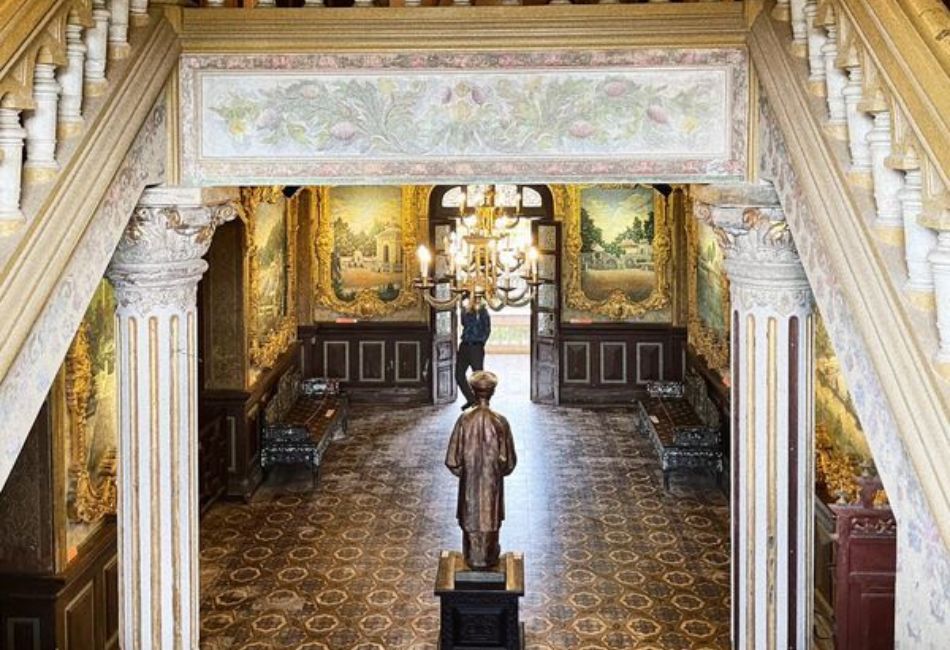
The palace combines colourful decorative surfaces with traditional Vietnamese imagery and European-inspired ornamental features. The careful use of colour, patterns and architectural decoration creates an interior that feels considerably different from the restrained wooden architecture found in many earlier Hue buildings. The palace therefore provides an excellent example of how artistic tastes were changing during Khai Dinh’s reign.
Instead of abandoning traditional symbolism, craftsmen incorporated familiar motifs into a new architectural setting.
4.2. Royal Furniture and Personal Objects
The preserved furniture and objects inside An Dinh Palace make the visit more intimate. Hue Tourism reports that visitors can see furniture, household objects and historical displays connected with the royal family, including items associated with Bao Dai.
Among the displays are royal furniture, a bed associated with the emperor and objects reflecting the lifestyle of the palace. These details help visitors imagine the palace as a lived-in residence rather than simply a historical monument.
4.3. The Story of Bao Dai’s Family
Perhaps the most compelling aspect of An Dinh Palace is its connection with Bao Dai and his family.
Vietnam Tourism notes that Bao Dai spent part of his youth here and returned to the palace during his reign. The upper floors have also been used to display historical photographs illustrating the life of Bao Dai, Queen Nam Phuong and their children. This creates an unusual bridge between the distant world of the Nguyen emperors and the more modern twentieth century.
Visitors can see how royal life changed as Vietnam entered a period of growing European influence, political transformation and eventual transition away from monarchy.

5. Why An Dinh Palace Is Different from the Imperial City
Visiting An Dinh Palace after the Imperial City can be particularly rewarding because the two sites reveal very different sides of royal life. The Imperial City was the ceremonial and political heart of the Nguyen Dynasty. Its gates, palaces, temples and courtyards were designed to express royal authority and follow strict principles of court hierarchy.
An Dinh, by contrast, feels more intimate. Its rooms, furniture, family photographs and residential history allow visitors to imagine the royal family as people rather than distant political figures.
This difference makes An Dinh Palace an excellent complement to the Imperial City rather than a replacement for it. The two sites together show both the public and private sides of the Nguyen royal world.
The architectural contrast is also fascinating. The Imperial City is strongly rooted in traditional Vietnamese imperial architecture, while An Dinh reflects the cultural changes taking place during the final decades of the dynasty. The combination of traditional motifs and European influences makes the palace an important record of this transitional period.
6. An Dinh Palace as Part of Hue’s World Heritage
An Dinh Palace belongs to the wider heritage landscape of Hue, which UNESCO recognizes as the Complex of Hue Monuments. UNESCO describes Hue as the political, cultural and religious centre of the Nguyen Dynasty from 1802 to 1945 and highlights the relationship between its architecture, the Perfume River and surrounding natural landscape.
This broader context is important when visiting An Dinh Palace. The palace is not an isolated building. It belongs to a network of royal and cultural sites that includes the Imperial City, temples, pagodas and royal tombs. Exploring these places together allows travellers to understand how the Nguyen Dynasty created an architectural and cultural landscape that still defines Hue today.
For visitors interested in heritage tourism, this makes An Dinh a valuable addition to a Hue itinerary, particularly for travellers who want to see something beyond the most familiar monuments.

7. What to See Near An Dinh Palace
Because An Dinh Palace is located relatively close to central Hue, it is easy to combine with other experiences.
After visiting the palace, travellers can continue toward the Perfume River, explore local markets or visit other historical landmarks in the city. The palace also works well as part of a broader heritage itinerary that includes the Imperial City, Thien Mu Pagoda and royal tombs.
For travellers who want to balance historical sightseeing with local life, the journey can continue beyond central Hue toward La Chu Village, where a very different side of the destination can be experienced through farming, cycling, traditional food and interaction with local families.
Our Hue Local Guide can help travellers discover the relationship between Hue’s historical landmarks and its everyday culture, while our Hue Tour 2 Days: Historical Sites and Rural Life Experience combines royal heritage with a countryside experience in La Chu Village.
This combination is particularly interesting because it shows that Hue’s heritage does not end at the palace walls.
8. How to Include An Dinh Palace in Your Hue Itinerary
For a first visit to Hue, An Dinh Palace can be included as part of a historical and cultural day without requiring a major detour. A heritage-focused itinerary could begin at the Imperial City, continue through the city’s historic streets and then visit An Dinh to explore the private and residential side of the Nguyen royal family.
From there, you can continue to Thien Mu Pagoda and enjoy a dragon boat ride along the Perfume River, or visit one of the royal tombs in the afternoon. If you have two days in Hue, consider dedicating one day to imperial heritage and another to rural life. The first day can include the Imperial City, An Dinh Palace, Thien Mu Pagoda and royal tombs, while the second day can take you into La Chu Village for a local market visit, cycling, farming and cooking.
For travellers interested in food, you can also connect the historical experience with a Cooking Class in Hue: From Farm to Table Experience, where a visit to a local market and Madam Thu Farm is followed by hands-on preparation of traditional Hue dishes.
This combination allows you to experience the city from several perspectives: royal history, architecture, food and everyday local life.

9. Why You Should Visit An Dinh Palace
There are many reasons to add An Dinh Palace to a Hue itinerary, particularly if you have already seen the Imperial City and want to understand more about the final generation of the Nguyen dynasty.
The palace offers a different kind of historical experience. Its European-influenced architecture reflects the cultural transformation of early twentieth-century Vietnam, while its preserved furniture, photographs and family-related displays create a much more personal connection with the royal family.
It is also an attractive destination for architecture lovers. The combination of Vietnamese decorative traditions and European forms is unusual, and the contrast between the palace’s elaborate exterior and intimate interior makes the visit rewarding for photographers as well as history enthusiasts.
Most importantly, An Dinh Palace helps complete the story of Hue. The Imperial City shows the formal power of the Nguyen court. The royal tombs reveal the personalities and ambitions of individual emperors. Thien Mu Pagoda shows the spiritual side of the city. An Dinh adds another chapter: the changing lifestyle of the royal family during the final decades of the monarchy.
Conclusion
An Dinh Palace may not be as internationally famous as Hue’s Imperial City, but that is precisely part of its appeal. The palace offers travellers an opportunity to discover a quieter and more intimate chapter of Vietnam’s royal history, one that focuses not only on ceremonies and political power but also on residence, family life and cultural transformation.
Built and reconstructed during the reign of Emperor Khai Dinh, the palace reflects the moment when traditional Vietnamese court culture encountered strong European influences. Its ornate gate, Trung Lap Pavilion and Khai Tuong Lau demonstrate this architectural transition, while the interior displays provide a glimpse into the lives of Bao Dai and the final generation of the Nguyen royal family.
For travellers exploring Hue, An Dinh Palace is therefore more than another historic building. It is a place where the old and new meet, where Vietnamese royal traditions blend with European design, and where the story of Hue continues from the grand Imperial City into the more personal spaces of the royal family.
If you want to understand Hue beyond its most famous monuments, take the time to visit An Dinh. Walk through the decorated halls, examine the furniture and photographs, look closely at the architectural details and imagine the lives of the people who once called this place home. Then continue beyond the palace and discover the other side of Hue through its food, villages, farms and local communities.
That combination of royal heritage and everyday life is what makes travelling through Hue so rewarding.
0 Comment